
Two streams, Paint Branch and Indian Creek, meet in the southeast corner of College Park to form the Northeast Branch of the Anacostia River. The city sits at about 69 feet above sea level, low by local standards, and the ground near that confluence collects runoff from a long reach of suburban Montgomery and Prince George's counties. Add more than 34,000 residents, a large university and a housing mix that runs from Queen Anne houses to new mid-rise apartments, and water problems here come in many forms.
The Restoration Job doesn't do the repairs; it's a no-cost phone referral service. Call (888) 317-9980 at any hour and we'll connect you with an independent restoration provider that works in College Park. Below is what tends to go wrong in this city and what a sensible recovery involves.
How the call works: when you call (888) 317-9980, The Restoration Job connects you with an independent restoration provider that serves College Park. That provider inspects the damage, explains the scope and quotes the work. The Restoration Job doesn't perform restoration itself. Read our referral disclosure.
Where Paint Branch and Indian Creek Meet
Paint Branch rises near Spencerville and runs about 17 miles, draining roughly 20.8 square miles before it joins Indian Creek inside the city. Prince George's County's own flood program lists two College Park stretches among its ten highest-priority problem areas: Paint Branch along Cherry Hill Road, with 18 flood-prone structures, and Indian Creek along U.S. Route 1, with 29. Lake Artemesia, the 38-acre lake between the two streams, was dug out in the late 1980s for Metro Green Line gravel rather than built as flood storage.
History shows what heavy rain can do here. During Tropical Storm Agnes in June 1972, the county recorded flooding in the Lakeland section of College Park, one of several inner-county areas that took water. More recently, on September 10, 2020, the National Weather Service named the Prince George's suburbs among the hardest-hit places when two to five inches of rain fell across the region, mostly within two hours.
Lakeland, Old Town and the Older Housing Near Campus
College Park dates to 1856 and was incorporated in 1945, absorbing neighborhoods such as Calvert Hills, Old Town, Lakeland, Berwyn and Hollywood. Many houses in these areas are decades old, and an older house here may have a basement, aging drain lines and gutters that empty close to the foundation. In blocks close to the university, a lot of these homes are rented to students, which raises a practical problem: nobody notices a slow leak in a basement bedroom until the carpet smells or a ceiling stains.
Landlords and tenants should agree on who checks sump pumps and floor drains before storm season. If a sewer line backs up into a basement, report it to WSSC Water at 301-206-4002 and treat the area as contaminated. A provider offering sewage cleanup will remove porous materials the water touched and disinfect before drying begins.
New Apartments Along Route 1 and Leaks That Spread Downward
Since the 2014 Greater College Park initiative, a public-private effort of roughly $2 billion, the Route 1 corridor has filled with mid-rise and high-rise apartments. In those buildings, the usual emergency is mechanical rather than weather-driven: a failed washing machine hose, a cracked toilet supply line, a sprinkler head damaged during move-in. Water follows the concrete deck and pipe penetrations down to lower units and sometimes into retail space below.
Report the leak to building management first, since the shut-off may be in a unit or mechanical room you cannot reach. Renters should photograph their belongings and contact their own renters policy; the building's coverage generally applies to the structure, not a tenant's possessions.
Wind, Trees and the 2001 Tornado
College Park has experience with violent wind. On September 24, 2001, a multiple-vortex F3 tornado struck the area, killing two people, injuring 55 and causing about $101 million in property damage. Severe thunderstorms are far more common than tornadoes, but they produce the same chain of problems on a smaller scale: a limb punctures a roof, rain enters the attic, and insulation and ceiling drywall soak through before anyone can tarp the opening. Prompt storm damage cleanup keeps a roof puncture from turning into a whole-floor drying job.
Drying Out a College Park Basement Without Inviting Mold
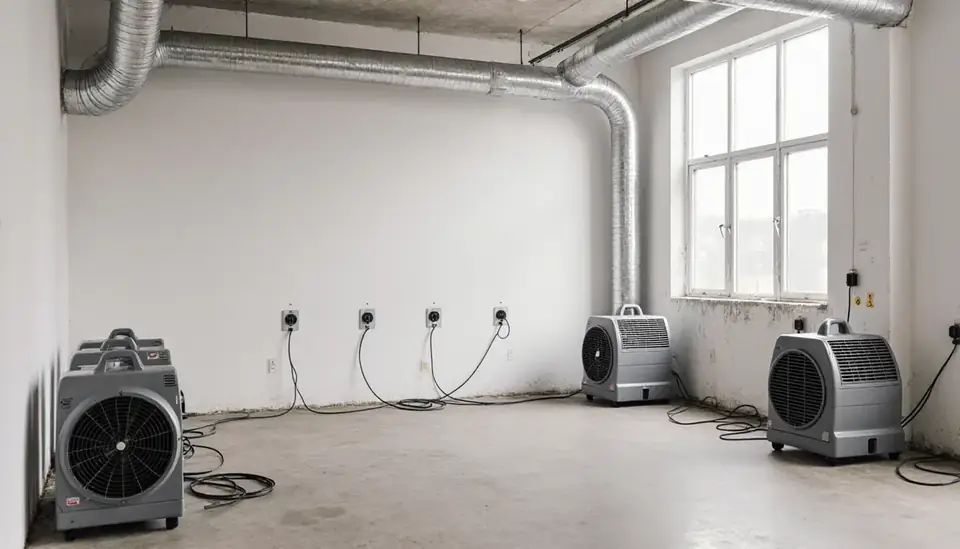
Summer humidity in the Washington area keeps basements damp even without a leak, so a flooded lower level here rarely dries by itself. A sound flood cleanup in College Park usually runs in this order:
- Stop the source, or wait for the creek or storm drain to drop, and shut off power to wet circuits.
- Photograph everything for the insurer or landlord before removal.
- Extract standing water and pull saturated carpet and pad.
- Cut wet drywall above the wick line and open wall cavities.
- Run dehumidifiers and air movers, logging moisture readings daily until materials test dry.
Mold can begin growing on wet drywall paper and carpet backing within a day or two in warm weather. If an old leak left a musty smell or spotting, mold remediation means containing the area, removing affected material and fixing the moisture that caused it.
College Park Neighborhoods and Surrounding Towns
Calls come in from across College Park, including:
- Old Town
- Calvert Hills
- Lakeland
- Berwyn
- Branchville
- Hollywood
- College Park Woods
- Crystal Springs
- Cherry Hill
- Lord Calvert Manor
The same line also serves nearby communities such as:
- Hyattsville
- Greenbelt
- Berwyn Heights
- Riverdale Park
- University Park
- Beltsville
- Adelphi
Questions From College Park Property Owners
My rental near campus flooded. Who is responsible for the cleanup?
The property owner is typically responsible for the building itself: walls, flooring, plumbing and the drying work. Your belongings fall under your own renters coverage, if you have it. Notify the landlord in writing right away, photograph damaged items and keep receipts for anything you replace. If the landlord is slow to respond, document the dates, because lingering moisture in a basement unit can become a mold problem within days.
Is my house near Paint Branch or Indian Creek in a flood zone?
Some properties near those streams are in mapped floodplains and many are not. Check your address with the Maryland Department of the Environment's flood map tool, which shows both current and preliminary flood risk. Standard homeowners policies do not cover surface flooding, so if you are close to either stream, ask an agent about separate flood coverage before the next big storm.
Water is coming up through my basement floor drain. What should I do?
Stop using sinks, toilets and washing machines, since that water has nowhere to go but back into the basement. Keep people and pets out of the affected area. Report a suspected public sewer backup to WSSC Water at 301-206-4002. Then call (888) 317-9980 and we'll connect you with an independent provider in College Park that handles sewage cleanup.
How fast does a flooded basement need attention in summer?
As soon as it is safe. Warm, humid air slows evaporation and speeds mold growth, so wet carpet pad and drywall should come out within the first day or two. Running a box fan alone rarely dries a basement in July; commercial dehumidifiers and moisture readings are what confirm the space is actually dry.