

Spanish walnut trees once filled the mountain pass where Nogales grew up, and the town took its name from them. Incorporated in 1893 and now home to about 19,800 people, the Santa Cruz County seat sits at roughly 3,800 feet on the international line, sharing the pass with Nogales, Sonora. Together they form the largest cross-border urban area in Arizona. Hills rise on both sides of the city, and when a summer storm parks over them, water moves fast toward the low ground in the middle.
The Restoration Job connects callers with local help for free. Dial (888) 317-9980 at any hour and we will put you in touch with an independent restoration provider that works in Nogales and the surrounding county. We do not perform the work, and each provider sets its own availability and pricing.
How the call works: when you call (888) 317-9980, The Restoration Job connects you with an independent restoration provider that serves Nogales. That provider inspects the damage, explains the scope and quotes the work. The Restoration Job doesn't perform restoration itself. Read our referral disclosure.
Everything Drains to Nogales Wash
The city's storm drains are built to move street runoff through smaller local channels into Nogales Wash, which in turn carries it north to the Santa Cruz River. Santa Cruz County's hazard mitigation plan lists Nogales Wash and Potrero Creek among the county's major watercourses, along with dozens of smaller washes that stay dry until a storm hits. The City of Nogales notes that growth has added pavement and rooftops, and that more hard surfaces have made long-standing flooding problems worse.
On a hillside lot, that usually means water racing down a driveway or street and finding a door threshold, a basement window or a garage. In the lower parts of town, it means storm drains that back up when they cannot keep up. Either way, the water is carrying grit and street runoff, so the cleanup should be handled as flood cleanup: extraction, removal of soaked porous materials and disinfection.
July Is the Month to Watch
Nogales averages about 14.6 inches of precipitation a year, more than many Arizona desert towns, and July alone accounts for over 4 inches. The National Weather Service in Tucson treats June 15 through September 30 as monsoon season and calls flash flooding the deadliest thunderstorm hazard. Santa Cruz County has been part of 33 federal or state disaster declarations between 1990 and early 2022.
Before the season starts, clean out gutters and downspouts, make sure soil slopes away from the foundation, and check that yard drains and culverts on your property are not packed with sediment from last year. The county's ALERT network posts live rainfall and stream gauge readings, which can show you how hard it is raining upstream before water arrives.
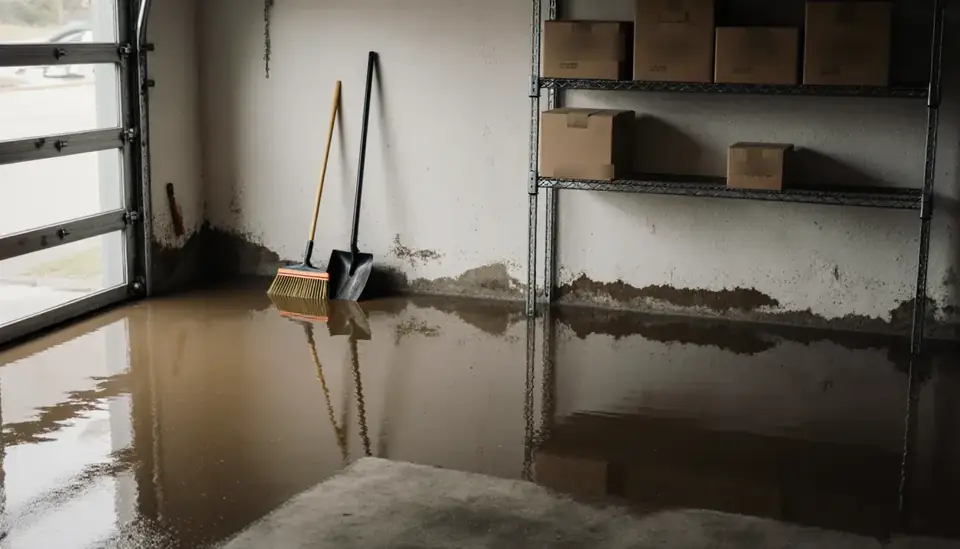
When the Storm Drain and the Sewer Both Fill Up
Intense rain can overload sewer and storm systems at the same time. When a floor drain, toilet or shower gurgles and backs up during a storm, assume the water is contaminated. The City of Nogales runs a wastewater program that includes pretreatment rules and monitoring of the International Outfall Interceptor, but problems inside a private service line are the owner's to deal with.
- Close off the room and keep kids and pets out until it is cleaned.
- Do not run fans that blow air from a contaminated room into the rest of the house.
- Throw out porous items that soaked up sewage, such as carpet pad and upholstered furniture.
- Have a sewage cleanup provider handle removal and sanitizing.
Water from a broken supply line is a different job, but if it sits for more than a day or two it can pick up contamination too.
Permits, Flood Maps and Insurance
The Santa Cruz County Flood Control District handles floodplain management for both the unincorporated county and the City of Nogales. Building in a mapped flood-prone area requires a floodplain use permit, and the district has kept elevation certificates for new structures since June 2001. It also offers flood hazard determinations for individual properties and site visits with written suggestions for protecting a building.
Standard homeowners policies typically do not pay for water that enters from outside the house. If your home sits near a wash or on low ground, ask the district about your property's flood risk and look up the address on FEMA's flood map before deciding whether to buy a separate flood policy. After a loss, photograph everything before it is removed and keep receipts for any emergency work.

Keeping Mold Out After a Wet Summer
With July the wettest month of the year in Nogales, late summer brings the most humid stretch, and homes closed up with the air conditioning running can hold moisture in wall cavities and under flooring. Mold commonly turns up behind baseboards after a flood, in closets on exterior walls, and under sinks where a slow drip went unnoticed. Drying wet materials completely within the first day or two is the most reliable prevention. If growth covers more than a small area or comes back after cleaning, a mold remediation provider can set up containment and remove affected materials.
Where Callers in the Nogales Area Are
The same line also serves nearby communities such as:
- Rio Rico
- Kino Springs
- Tubac
- Tumacacori-Carmen
- Amado
- Patagonia
- Sonoita
Frequently Asked Questions
Who do I contact about drainage or flooding problems in Nogales?
Inside city limits, the City of Nogales stormwater staff can be reached at 520-285-5651 about storm drains and runoff. The Santa Cruz County Flood Control District handles floodplain permits and drainage complaints about filling or construction in the floodplain for both the county and the city. For a life-threatening flood, call 911 first.
How do I get flood and weather warnings for Santa Cruz County?
Santa Cruz County Alerts, run by the county's Office of Emergency Management, sends weather alerts, emergency notifications and boil-water notices. Landlines are enrolled automatically, but mobile phones have to opt in. The National Weather Service office in Tucson also issues flash flood warnings for the county, and the county ALERT gauge map shows live rain and stream readings.
Water came in from the street during a storm. Is that covered by my homeowners policy?
Often it is not. Most homeowners policies exclude surface water and flooding, which is covered by separate flood insurance. Damage from a burst pipe or a sudden appliance failure is more often covered. Call your agent to confirm, document the damage with photos and video before cleanup starts, and keep any removed materials or samples until the adjuster says otherwise.