

Monroe County's northeast corner takes in a long stretch of Lake Ontario shoreline, the east side of Irondequoit Bay and the 550 acres of Webster Park on the lakefront. About 20,000 housing units are spread from the village to West Webster, Union Hill and subdivisions such as Gallant Fox, Oakmonte and Parkwood, and the majority are inland rather than on the shore. That shapes the risk: shoreline exposure for a relatively small number of lots, and basement, plumbing and roof issues for everyone else.
The Restoration Job does not send out crews; it is a free line that links callers with independent restoration companies. Call (888) 317-9980 and we'll connect you with a provider that serves Webster, whether it's a flooded finished basement in Glen Edith or ice-dam damage to a ceiling in the village.
How the call works: when you call (888) 317-9980, The Restoration Job connects you with an independent restoration provider that serves Webster. That provider inspects the damage, explains the scope and quotes the work. The Restoration Job doesn't perform restoration itself. Read our referral disclosure.
Lakefront and Bay-Side Lots in High-Water Years
Lake Ontario's level is measured just off this shoreline at the Ninemile Point gauge. The International Joint Commission reports that the lake peaked at about 248.95 feet in 2017 even with regulation, and 2019 set a higher record. In years like those, wind-driven waves reach farther up the bank, docks and breakwalls take a beating, and low parcels near the water can flood. Irondequoit Bay, which forms the town's western edge, rises with the lake, so low bay-side properties near Sandbar Park share the same risk.
A few practical points for shoreline owners:
- Check your parcel on FEMA's flood map and keep a copy of any elevation certificate.
- Flooding and wave damage generally fall under a flood policy, not a homeowners policy, and new flood policies typically take 30 days to start.
- Move furnace, water heater and electrical service off the lowest level where possible.
Subdivision Basements and Spring Seepage
Away from the lake, the typical call involves a finished basement. Snowmelt and spring rain soak the ground around the foundation, and water finds its way in through wall cracks, window wells or the joint where floor meets wall. A sump pump that can't keep up, or that loses power in a storm, turns damp carpet into standing water in a few hours. A burst washer hose or a failed water heater does the same thing on a dry day.
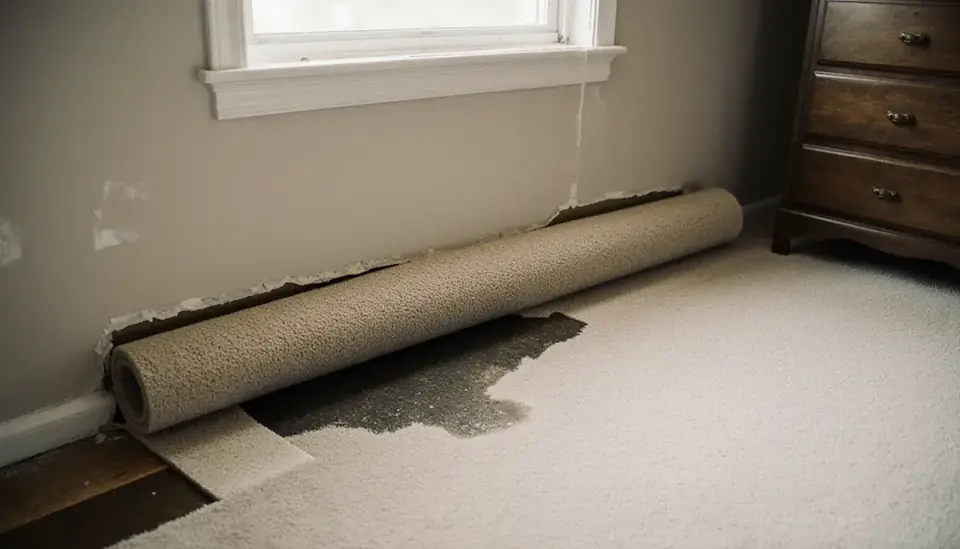
Speed matters with finished space. Fast water extraction pulls water out of carpet and pad before it wicks into drywall and baseboards, and that can be the difference between drying in place and removing the bottom of every wall. Ask the provider to take moisture readings at the start and at the end, and keep those records for your claim.
What a Drying Job Looks Like Here
After the source is fixed, a crew will usually remove wet pad, pull baseboards and drill or cut the lower drywall if moisture has wicked up behind it, then set air movers and dehumidifiers. In a cold, humid spring the drying equipment does most of its work against the outside air, so jobs can take longer than people expect. Check that insulation inside exterior basement walls is dried or replaced, since wet fiberglass behind drywall is a common hidden problem. For a deeper explanation of the drying phase, see structural drying.
Roofs and ceilings are the other common source. Long winters with heavy snow lead to ice dams along eaves, and the resulting leaks often show up as stains on upstairs ceilings or wet insulation in the attic.
Keeping Lakeside Humidity from Turning into Mold
Summer air near the lake carries a lot of moisture, and a basement that is a few degrees cooler than outside will pick up condensation on walls and ductwork. After any leak, look for mold on the back side of drywall, on carpet tack strip and on stored boxes. Mold remediation in New York falls under a state program, and the assessor and the remediation company are supposed to be separate businesses, so ask how a contractor handles that. For anything beyond a small patch, professional mold remediation with containment is the safer route.
Areas In and Around Webster
Calls come in from across Webster, including:
- Webster village
- West Webster
- Union Hill
- Glen Edith
- Forest Lawn
The same line also serves nearby communities such as:
- Irondequoit
- Penfield
- Walworth
- Ontario
- Rochester
Frequently Asked Questions
My Webster house is on the lake. Can I tell when water levels are getting dangerous?
The Ninemile Point gauge off the town's shoreline reports Lake Ontario's level, and the International Joint Commission posts water level updates and forecasts. Compare current readings with 2017 and 2019, when the lake set records, and watch for strong north winds during high-water periods, since waves do most of the damage. Move valuables and equipment off the lowest floor early when forecasts call for a rising lake.
Who pays when a neighbor's drainage floods my basement?
It depends on the cause. Damage from surface water is usually treated as flooding, which a homeowners policy generally excludes, while a sudden pipe or appliance failure in your home is typically covered. Disputes over grading or redirected runoff between lots are civil matters. Document the water's path with photos and video while it is happening, and talk with your insurer before cleanup starts.
Should I keep the finished drywall in my basement after a leak?
If the water was clean and the drywall was wet for only a short time, it can often be dried in place with moisture readings to confirm. If it soaked for more than a day or two, if insulation behind it is wet, or if the water came from outside or a drain, removing the lower portion is usually the safer choice. A restoration provider can measure moisture inside the wall before deciding.