
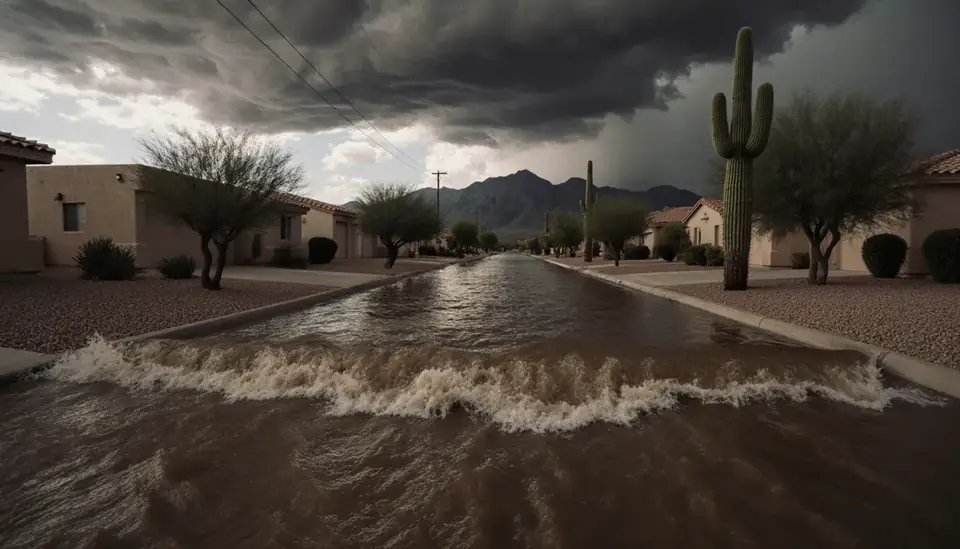
New Mexico gets most of its serious flooding from short, violent summer storms rather than long rainy seasons. The monsoon typically builds in July, and a single thunderstorm can dump more water on a hillside or arroyo in an hour than the ground can take. Wildfire has raised the stakes: in 2025 the National Weather Service in Albuquerque issued about a third of its flash flood warnings for burn scars covering less than one percent of its forecast area, mainly the Hermits Peak and Calf Canyon and Ruidoso-area scars.
The Restoration Job is a free referral service with a 24/7 line at (888) 317-9980. We connect callers with independent, third-party restoration providers that serve their area, from Albuquerque and Santa Fe to Las Cruces and Farmington. We don't perform the work ourselves, and providers set their own schedules, though many often offer emergency service for flood cleanup and water removal.
Monsoon Storms Over the Rio Grande Valley and the High Desert
Albuquerque averages about 4.5 inches of rain during the monsoon, a large share of its yearly total, and much of it falls in brief, intense bursts. Arroyos carry that runoff through neighborhoods, low-water crossings flood, and yards graded toward the house send water under garage doors and through stucco cracks. The NWS notes that Arizona and New Mexico together see more than 1.5 million lightning strikes a year, and thunderstorm winds and hail can damage roofs and windows ahead of the rain.
Winter brings a different set of problems. Much of the state sits at high elevation, so hard freezes reach Santa Fe, Taos, Los Alamos, Gallup and the northern mountains every year. Pipes in exterior walls, crawl spaces and unheated garages can split, and the leak often shows up only when temperatures rise and water starts flowing again.
Burn Scars, Debris Flows and Ruidoso's Floods
Burned slopes shed water and ash much faster than healthy forest. After the 2022 Hermits Peak and Calf Canyon fire, the New Mexico Department of Homeland Security and Emergency Management warned that storms could drop one to two inches of rain in under an hour over the burn area and that flood risk would stay high through the monsoon until vegetation recovers. The South Fork Fire near Ruidoso in 2024 was followed by flooding and debris flows that summer, and on July 8, 2025 about 2.6 inches of rain in two hours over the burn scar sent the Rio Ruidoso to a record crest of 17.93 feet, with three deaths reported by the NWS.
Homes downstream of recent burn areas can flood even if they never did before. Mud and ash in floodwater make cleanup heavier than a clean-water leak, and contaminated water is generally treated like sewage cleanup, with porous materials removed rather than dried.
Flat Roofs, Adobe and Stucco Homes
Pueblo Revival and territorial-style houses, common in Santa Fe, Albuquerque and Taos, often have flat roofs with parapets that drain through canales. When a canale clogs or a roof membrane cracks, water pools and seeps into ceilings and the tops of walls. Adobe and stucco can hold moisture longer than wood framing, and trapped water can cause plaster to bubble or crumble. Newer homes across the state are mostly slab-on-grade, where water heater failures, supply-line breaks and slab leaks are the usual culprits.
A restoration provider will typically find and stop the source, extract water, remove wet materials that cannot be saved, and run dehumidifiers and air movers for structural drying while tracking moisture readings. Dry air helps, but walls and subfloors still need to be measured rather than assumed dry, and mold can develop in hidden pockets that stay damp after a slow leak or a monsoon soaking.
Flood Insurance, Emergency Management and New Mexico Contractors
Standard homeowners policies generally exclude flood, including surface runoff and debris flows, so coverage has to be purchased separately through the National Flood Insurance Program or a private insurer, usually with a waiting period before it takes effect. FEMA's Flood Map Service Center shows mapped flood zones, though maps may lag behind the changed risk below new burn scars.
The New Mexico Department of Homeland Security and Emergency Management coordinates statewide disaster response and posts flood and wildfire information. Construction contractors are overseen by the Construction Industries Division of the Regulation and Licensing Department, which offers a contractor license lookup; confirm current requirements with CID before hiring someone for repair or rebuild work.